
The Advocate
Georges Media (NOLA, The Advocate)News & Magazines
3.7250.00 Reviews
- Version
- 4.1.0
- Installs
- 50.00K
- Age Rating
- Everyone
Screenshots


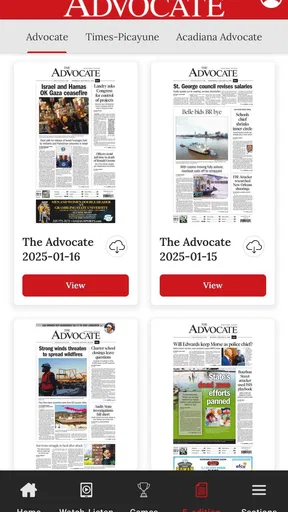
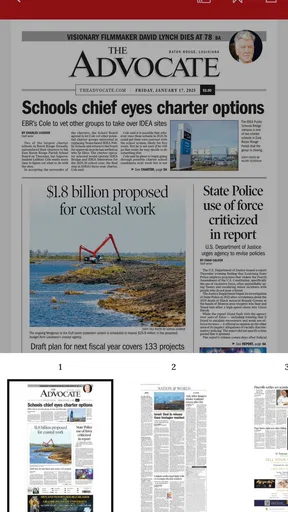

Our Review of The Advocate
 Analysis by Appyee
I keep coming back to The Advocate for one simple reason: it puts local news at the center instead of treating it as a small section inside a huge national news feed. Developed by Georges Media, the app is built for readers who want a direct way to follow nearby events, public decisions, community developments, and other stories that can affect daily life. That focus sounds modest, but it changes how I use a news app. I am not opening it mainly to chase every headline on the internet; I am opening it to understand what is happening around me.
The app belongs to the News & Magazines category, is free to install, and is suitable for everyone. It has been available since May 4, 2012, and its current version is 4.1.0 for devices running Android 8.0 or later. Its average score is 3.7 from over 700 ratings, with more than 200 written reviews and over 50 thousand installs. Those figures suggest a useful but not universally loved local-news tool, which matches my experience: the central idea is valuable, while the overall experience depends heavily on what kind of reader you are and how much polish you expect from a mobile publication.
Local coverage is the reason to install it
The Advocate’s strongest capability is its concentration on up-to-date local reporting. In practice, that means the app makes more sense when I want news tied to a particular place than when I want a broad mixture of international headlines, technology stories, entertainment, and opinion from everywhere. A general aggregator may offer more variety, but it can also bury the story that matters most to someone living in the area under a constant stream of larger national events.
That local emphasis affects the value of the app in a very practical way. A national news application can tell me that a policy debate is happening, but a local publication is more likely to help me understand how a decision connects with the community around me. The distinction is important because local news often has a shorter shelf life and a more immediate effect. A change involving schools, roads, local government, businesses, or neighborhood events may not become prominent in a general-purpose feed, yet it can still be the story I most need to see.
I also appreciate that the app is not trying to be everything at once. Its store summary points clearly toward access to current local news, and that narrow purpose makes it easier to decide when to open it. If I want a quick overview of worldwide events, I would use a broader news service. If I want a local starting point, this app has a clearer identity.
That identity is also the first trade-off. Local coverage is only useful if the places and subjects you care about fall within the publication’s reporting focus. Someone who moves frequently, follows several regions, or wants a single app for many countries may find the selection too narrow. I would not install it expecting a replacement for every other source on my phone. I see it more as a focused local window that can sit beside a wider news app.
What opening the app feels like
My most useful habit with The Advocate is to treat it as a short check-in rather than a background stream that stays open all day. I open it when I have a few minutes, scan the leading local stories, and decide which item deserves deeper attention. That approach suits the app’s purpose better than endlessly scrolling for novelty. The value is in finding relevant reporting efficiently, not in producing an unlimited feed.
A realistic example is a weekday morning before leaving home. I might already know the major national headlines from another source, but I still want to see whether anything local could affect my plans. A local news app can be more useful at that moment because it helps me look for nearby developments rather than repeat information I have already seen elsewhere. If a story concerns the community directly, I can give it more time; if not, I can close the app without feeling that I have missed the point of installing it.
Another good use is checking the app after work when I want context about something I noticed during the day. Perhaps a local issue has generated conversation, or a community event has changed. Instead of searching the open web with vague terms and sorting through unrelated results, I can begin with a publication whose purpose is local reporting. That is a small workflow improvement, but it is one of the app’s more meaningful strengths.
I would advise new users to spend the first few sessions learning how the publication presents its coverage rather than judging it after one quick glance. Local news may not always produce dramatic headlines, and the most useful article may be the one that explains an ongoing issue rather than the one with the most attention-grabbing wording. Reading with that expectation makes the app feel more purposeful.
Where the focused approach helps most
The best scenario for this app is a reader who lives in the area covered by The Advocate and wants a convenient mobile route into local reporting. It is especially suitable for someone who feels that large news platforms overlook nearby matters. I can imagine using it to keep up with community developments, follow a local issue over time, or maintain a basic connection with a place I care about even when I am not checking several separate websites.
It can also help readers who are trying to become more locally informed without committing to a long daily reading session. The app gives that habit a clear destination. Rather than opening a social network and hoping relevant news appears between unrelated posts, I can go directly to a local publication. That reduces the distraction that often comes with algorithmic feeds and makes my reading intention more deliberate.
For families, the everyone content rating also removes an obvious age-related barrier to general use. I would still encourage each reader to decide what is appropriate for their own household, because news topics can vary in seriousness, but the app is not positioned as an age-restricted entertainment product. Its purpose is straightforward access to local journalism.
The app may also suit people who have recently become more interested in civic life. Local reporting can feel more actionable than distant news because it connects with places, services, and institutions that readers encounter directly. The important point is not that every article will demand action. Rather, regular local reading can help me recognize the background behind conversations and decisions that otherwise seem disconnected.
There is a useful distinction between reading for awareness and reading for research. The Advocate works naturally as a daily awareness tool. If I need a complete archive, extensive cross-publication comparison, or a highly specialized research workflow, I would use additional sources. The app can start my understanding, but I would not assume that one publication should be the only voice I consult for a complicated subject.
What I would watch before relying on it
The 3.7 average rating tells me to keep expectations realistic. I would not interpret that score as a reason to dismiss the app, because a local-news application can be valuable even when readers disagree about navigation, article presentation, update behavior, or the breadth of coverage. Still, it is a reminder that the experience may not feel perfect to everyone. I would install it and judge whether the reading flow works comfortably on my own device before making it my only local source.
The free download is another reason it is easy to try, but the app includes in-app purchases ranging from around 20 dollars to 150 dollars per item. That is important for anyone who wants to keep all reading costs predictable. I would look carefully at any purchase screen before confirming anything, especially if I am sharing a device or handing it to a younger family member. The free entry point is convenient, but it should not be confused with a guarantee that every possible part of the experience will remain free.
This pricing structure creates a genuine decision for readers. Someone who only wants occasional headlines may prefer to stay with the free portion and use other sources when necessary. A frequent local-news reader may consider additional access worthwhile, depending on how much the app becomes part of their routine. I would make that decision based on actual reading habits rather than buying immediately. A few days of normal use should reveal whether the coverage is relevant enough to justify spending money.
Device compatibility is also worth checking. The current release requires Android 8.0 or later, so an older phone may not be able to run it. For most recent Android devices, that requirement should not be a major concern, but it matters if you are keeping an aging handset alive or installing apps on a secondary device. I would verify the operating system before planning to use it on a particular phone.
Another limitation is inherent in local publishing: relevance can change depending on where I am and what I care about. When I am away from the area, the app may become less immediately useful than a national or international service. That does not indicate a failure in the app’s purpose; it is simply the cost of choosing depth and proximity over geographic breadth. I prefer to understand that trade-off before installing it.
How it compares with broader news alternatives
Compared with a general news aggregator, The Advocate offers a more intentional starting point. Aggregators are convenient when I want many subjects in one place, and they are usually better for quickly comparing headlines from different publications. Their weakness is that local stories can be diluted by the volume of larger news. The Advocate reverses that priority, making nearby reporting the reason to open the app.
Compared with reading the publication through a mobile browser, a dedicated app can feel more direct because it gives the publication its own place on the phone. I do not have to begin with a browser tab or remember the exact route to the local coverage. The advantage is convenience and habit formation. The disadvantage is that a browser can be more flexible for jumping between sources, sharing research across tabs, or avoiding another installed application.
Compared with social media, the app offers a less chaotic way to encounter local information. Social platforms may surface community stories quickly, but they also mix reporting with personal reactions, reposts, incomplete context, and unrelated material. I would rather use social media to notice what people are discussing and then use a local publication to seek more grounded coverage. That two-step approach takes slightly longer, but it can reduce the risk of treating a fast-moving conversation as a complete news report.
Compared with television or radio, the app is better suited to reading at my own pace. I can choose the story that matters to me instead of waiting for a scheduled segment. Broadcast media may still be more convenient when I want passive updates while doing something else, so I would not describe the app as a universal replacement. Its strength is control: I decide when to check, what to read, and how long to stay.
Small habits that make it more useful
My first tip is to use it at consistent moments rather than reacting to every notification or headline. A morning check and an evening check, for example, create a manageable routine without turning local news into a constant interruption. This also helps me notice which topics are developing instead of judging every story in isolation.
My second tip is to read beyond the headline when a story could affect a decision. Local headlines can be compact, while the useful details may appear later in the article. If I am checking something related to plans, services, or community changes, I would allow enough time to understand the context before passing the information along. The app is most valuable when it improves understanding, not merely when it gives me another headline to repeat.
My third tip is to pair it with one broader source when I need perspective. This is not because local reporting lacks value; it is because different sources answer different questions. The Advocate can help me identify what is happening close to home, while a broader publication may explain national context or show how a similar issue is unfolding elsewhere. Using both prevents the local focus from becoming an information bubble.
I would also avoid judging the app only by how exciting the front page looks during a quiet news period. Local journalism has a different rhythm from a global breaking-news feed. Some days may offer several immediately relevant stories, while other days may be more useful for slower reporting and background. The app’s success for me depends on whether it supports a sustainable local-news habit, not whether every visit feels dramatic.
Who should choose it
I would recommend The Advocate to readers who want local news access without the noise of a general-purpose feed. It is a sensible choice if your main question is, “What is happening in the community I care about?” rather than, “What are all the biggest stories in the world right now?” Its free installation makes experimentation easy, and its focus gives it a clear role on an Android phone.
I would be more cautious if you want one application to cover multiple regions, compare many publishers, or deliver a highly personalized mixture of subjects. In those cases, a broad aggregator or a collection of publication apps may serve you better. I would also think twice if you dislike checking purchase terms or if your device does not meet the Android requirement. Those are practical concerns that can matter more than the app’s central idea.
For me, the deciding question is whether local relevance is worth giving up some breadth. If the answer is yes, the app earns a place in my news routine. I like that it does not need to compete with every category of information to be useful. It has a specific job, and that job is helping me stay connected to nearby reporting.
In the end, The Advocate is best understood as a focused local-news companion rather than a complete news universe. Georges Media has created an app whose main benefit comes from narrowing attention to the community level. The experience has limitations, including the uneven expectations reflected in its rating, the possibility of paid items, and the fact that its usefulness depends on geographic relevance. Even so, for the right reader, the focused local-news capability is more valuable than endless variety. I would install it if local awareness is a regular part of my day, keep a broader source for wider context, and decide about any purchase only after seeing how naturally the app fits my reading habits.
Verdict
Strengths of The Advocate
- Clear, accessible coverage of local news and community issues.
- Opinion pieces offer strong perspectives on current events.
- Articles are easy to browse on a mobile screen.
- Useful source for following regional politics and public affairs.
- Regular updates help readers stay informed throughout the day.
Limitations of The Advocate
- Coverage may feel limited outside the publication’s local area.
- Some articles can reflect a distinctly editorial viewpoint.
- Advertising may interrupt reading in parts of the app.
- Certain content may require a subscription or account.
- Notifications can become frequent if not carefully customized.
Other Releases by Georges Media (NOLA, The Advocate)
View All
NOLA.com
News & Magazines3.9
Similar Picks in This Category
View All
Google News - Daily Headlines
Google LLC4.0

X
X Corp.4.8

Flipboard:Your Social Magazine
Flipboard3.4

Opera News: breaking & local
Opera4.5

Hindi News by Dainik Bhaskar
Dainik Bhaskar Group4.0

Way2News Daily News App
Way2News ( Formerly Way2SMS )4.6
Frequently Asked Questions
What is The Advocate app, and what can I use it for?
The Advocate is designed to provide access to news, stories, commentary, and community-focused content related to LGBTQ+ life, culture, politics, and rights. After installing it, users can browse articles, keep up with current issues, and discover opinion and entertainment coverage in one place. The exact features and available sections may vary depending on the app version and region.
Is The Advocate free to download and use?
The Advocate can generally be downloaded without an upfront charge, allowing users to explore its available content after installation. However, some articles, premium features, subscriptions, or digital access options may require payment. Before subscribing, review the pricing, renewal terms, and account conditions shown in the app store or within the application, since these details can change over time.
Does The Advocate require an account or subscription?
You may be able to read some content without creating an account, but registration could be necessary for personalized features, saving articles, receiving notifications, or accessing restricted material. Certain content may also be available only through a subscription or membership. If you decide to subscribe, check whether billing is managed through Google Play or the Apple App Store and understand how cancellation works.
Can I receive notifications and personalize the content in The Advocate?
The Advocate may allow users to enable notifications for breaking news, new articles, special coverage, or other updates. Depending on the version installed, personalization options can include selecting topics, managing alerts, or saving content for later. Notifications can be disabled from the app’s settings or your device’s system settings if they become too frequent or you prefer to browse manually.
Is The Advocate available on both Android and iPhone, and is it safe to install?
Availability can differ by country, operating-system version, and the current publishing status in each official store. For the safest installation, download The Advocate only from Google Play or Apple’s App Store, verify the developer name, and check recent reviews before proceeding. Keep your device updated and review requested permissions, particularly if the app asks for access unrelated to reading content.
